A few days ago I went to my first conference: the Alliance for Community Media, in Madison, WI. It was their 50th anniversary, and a chance to put Raster in front of a few hundred people who actually run stations across the country. I didn’t go to validate a thesis, but to meet the people who have been carrying this thing for decades.
We didn’t have any fancy banners or signs. Just a TV, a laptop, and a bowl of Tootsie Pops.
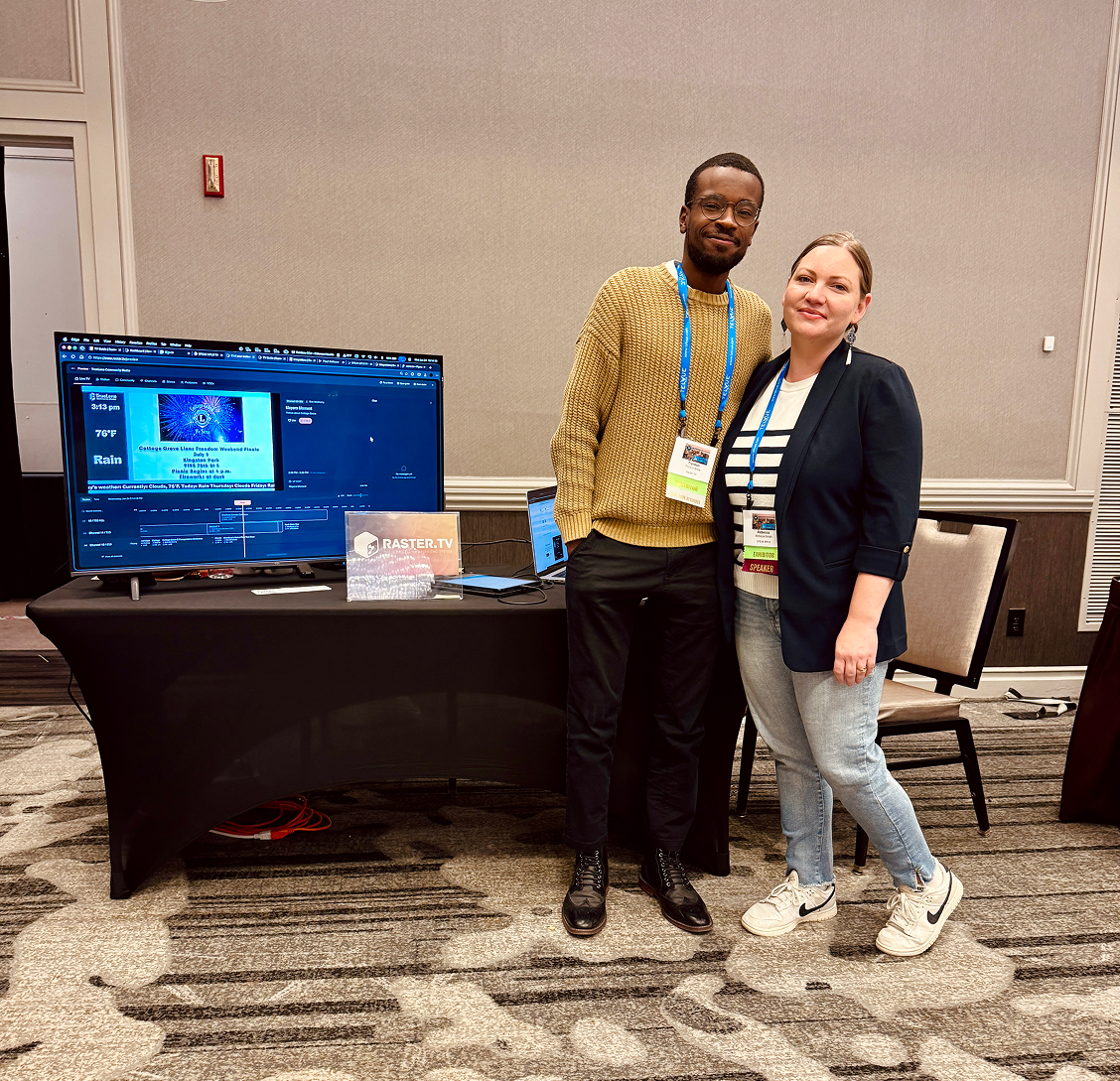
I had a simple plan: show stations on a screen, talk to operators, listen. Rebecca and her team from SPEAK MPLS were already in the room, which helped enormously.
By the end of the week I’d talked with operators, vendors, advocates, and a few people building parallel tools to preserve the movement, including Keri Stokstad’s Community Media Voices, an archive mapping the history, people, and stories that make this community so special.
I went in expecting product feedback which we got more than I could’ve hoped for, but the bigger takeaway was simpler: it’s not about the content, it’s about the relationships. Community media isn’t just programming. It’s a town square where everyone can participate in fostering civic memory through creativity, collaboration and community building. It’s clear to us that what we’re building is more than just a tool for saving time. It’s a place that deserves to be designed for everyone from the station managers behind the scenes to the producers creating the content and the viewers watching from home.
One thing that stuck: how much of the field is still held together by hand. Metadata re-keyed across traffic systems, spreadsheets, websites, and social posts. There isn’t currently a clean way to bring all of this data under the same roof while making content submission as easy as uploading a YouTube video. We hope Raster can be that platform.
This experience was something outside my comfortzone but I’m so glad I attended and I’m excited to attend more like this and absorb as much as I can along the way.
Big thanks to Tommy Shenefield for bringing this opportunity to me. It was an experience I won’t forget.